
The Hidden Dangers Behind Photokeratitis and Macular Degeneration
- Ifza zia
- Jan 24
- 3 min read
When we think of sun exposure, most people imagine a warm
day at the beach or the glow of healthy skin after some time
outdoors. However, dermatological and ophthalmic research
shows that the same ultraviolet (UV) rays that tan our skin can
also silently damage our eyes. Two major conditions linked to
this exposure are Photokeratitis and Macular Degeneration —
both of which highlight the critical importance of sun safety
beyond just our skin.
Understanding Photokeratitis: A Sunburn of the Eye
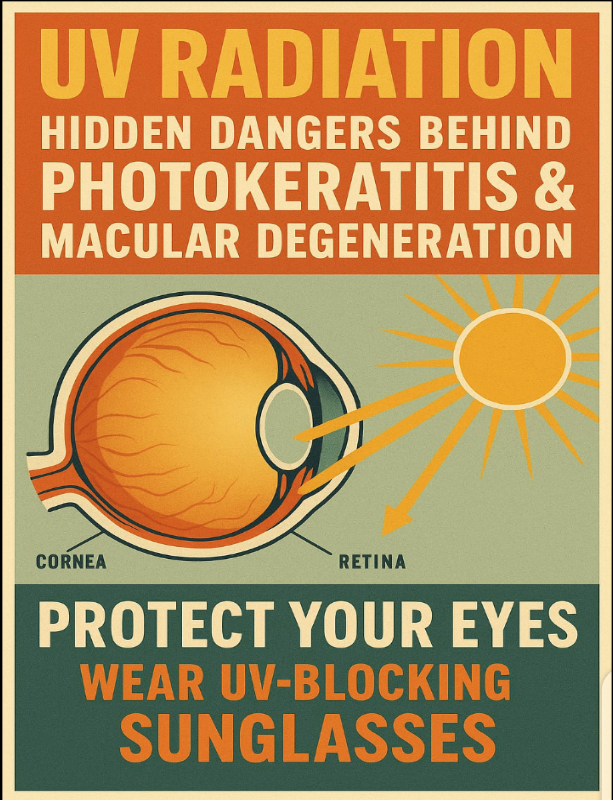
Photokeratitis is often described as “sunburn of the cornea,”
and it occurs when the eye’s surface is overexposed to UV
radiation. According to the American Academy of
Ophthalmology (AAO), even a few hours of intense UV
reflection—such as from snow, water, or sand—can cause
corneal cells to become inflamed, leading to symptoms like
tearing, pain, blurred vision, and the sensation of grit in the
eyes. Fortunately, the damage is usually temporary and heals
within 24–48 hours, but recurrent exposure increases long-
term risk for more severe conditions.
Exposure
In contrast to Photokeratitis, Age-Related Macular
Degeneration (AMD) is a chronic, progressive disease that
damages the macula—the central part of the retina
responsible for sharp vision. Over time, repeated UV and blue-
light exposure leads to oxidative stress within retinal cells,
causing them to deteriorate. Dermatological and ophthalmic
studies published in The Journal of Investigative Dermatology
show that oxidative damage to ocular tissues parallels the
mechanisms of photoaging seen in skin, reinforcing how
deeply UV exposure impacts multiple organ systems.
How UV Radiation Triggers Cellular Damage
The science behind these conditions lies in reactive oxygen
species (ROS). When UV rays penetrate tissues, they generate
free radicals that attack DNA, proteins, and lipids. In the
cornea and retina, this oxidative stress overwhelms natural
antioxidants, resulting in inflammation, tissue degeneration,
and in the case of AMD, loss of photoreceptor function.
Recent dermatological research emphasizes that both ocular
and cutaneous photodamage share this oxidative
pathway—making antioxidant protection and UV filters
equally vital for the eyes and skin.
Prevention: Protection Beyond Sunscreen
Protecting the eyes requires the same diligence we apply to
skin care. Experts recommend wearing UV-blocking
sunglasses, wide-brimmed hats, and avoiding prolonged
exposure during peak sun hours. For those frequently in
reflective environments like snowfields or beaches, wrap-
around sunglasses or goggles with 100% UVA and UVB
protection are essential. Interestingly, the Skin Cancer
Foundation highlights that using such protection not only
prevents ocular burns but may also reduce risk for cataracts
and AMD progression—showing how small habits lead to
large health gains.
The Broader Dermatological Perspective
From a dermatological standpoint, Photokeratitis and AMD
are part of a continuum of photo-induced disorders. Both are
preventable outcomes of cumulative UV exposure, yet often
overlooked because early damage is invisible. Integrating
dermatological and ophthalmic prevention
campaigns—focusing on whole-body photoprotection rather
than isolated care—could significantly reduce global UV-
related diseases. As research advances, cross-disciplinary
efforts are increasingly supporting the idea that eye protection
is a core element of overall skin health.
References
1. American Academy of Ophthalmology. (2023).
Photokeratitis and UV Eye Damage. Retrieved from
2. Roberts, J. E. (2019). Ultraviolet radiation as a risk factor
for cataract and macular degeneration. Eye & Contact Lens,
45(5), 343-349.
3. Yaar, M., & Gilchrest, B. A. (2018). Photoaging and
photodamage in human skin. The Journal of Investigative
Dermatology, 138(2), 233-240.
Comments